COA Rates
Last updated: January 27, 2026
COA (Contract of Affreightment) rates are used to model long-term, contracted pricing agreements between a carrier and a customer. COA rates allow you to define:
Fixed origin → destination pricing
Pricing along a defined route
Product volume ranges
Base and supplemental charges
Demurrage and free time
Validity windows and routing logic
Once configured, COA rates are automatically evaluated and applied when a voyage matches the contract terms.
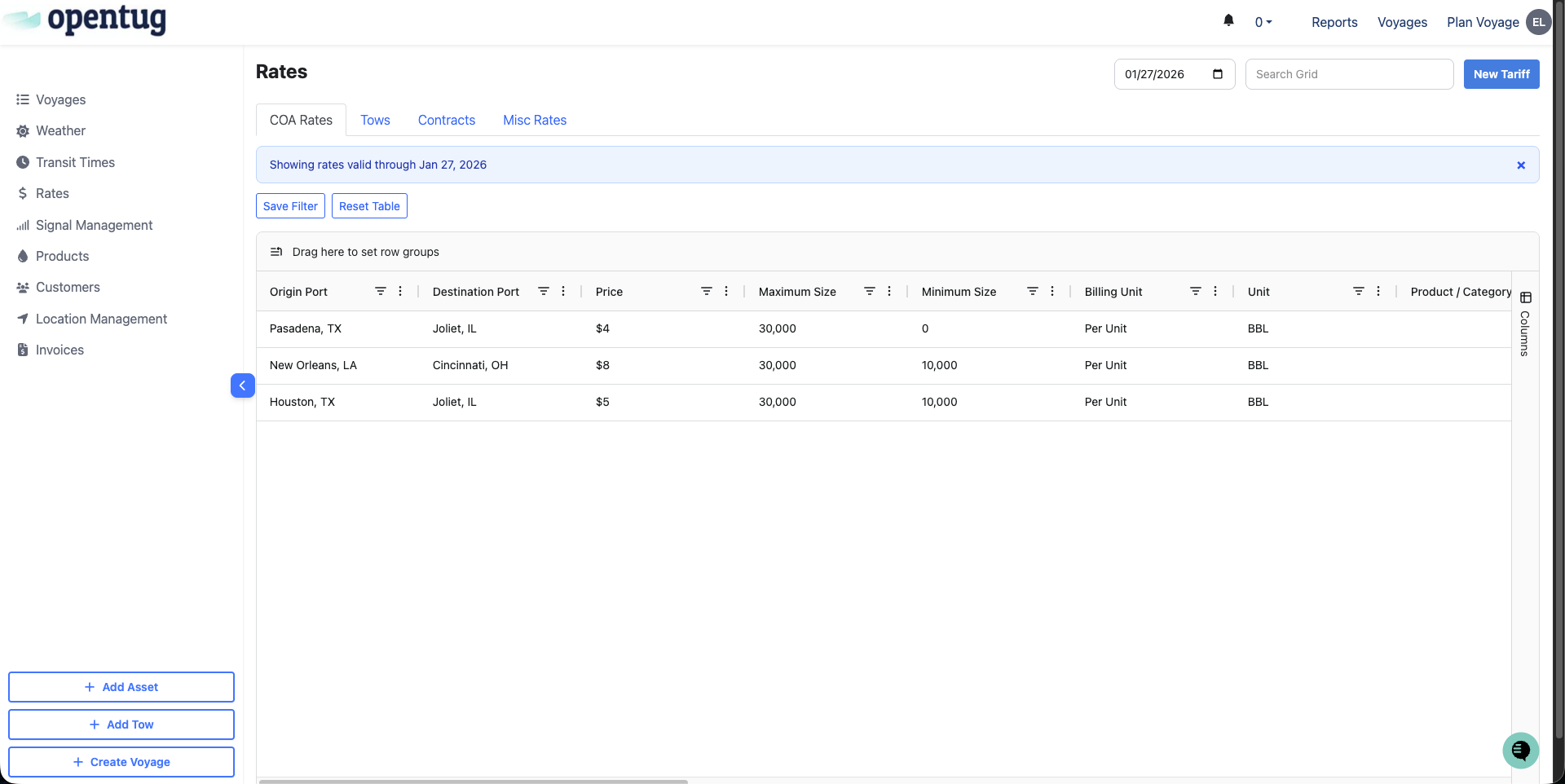
Viewing COA Rates
COA rates live under Rates → COA Rates.
From the COA Rates table, you can:
View all active COA pricing
Filter by rate parameters (e.g. origin, destination, product, billing unit, etc.)
See which rates are valid as of a specific date
Save commonly used filters
Creating a COA Tariff
To create a new COA tariff, click New Tariff from the COA Rates tab.
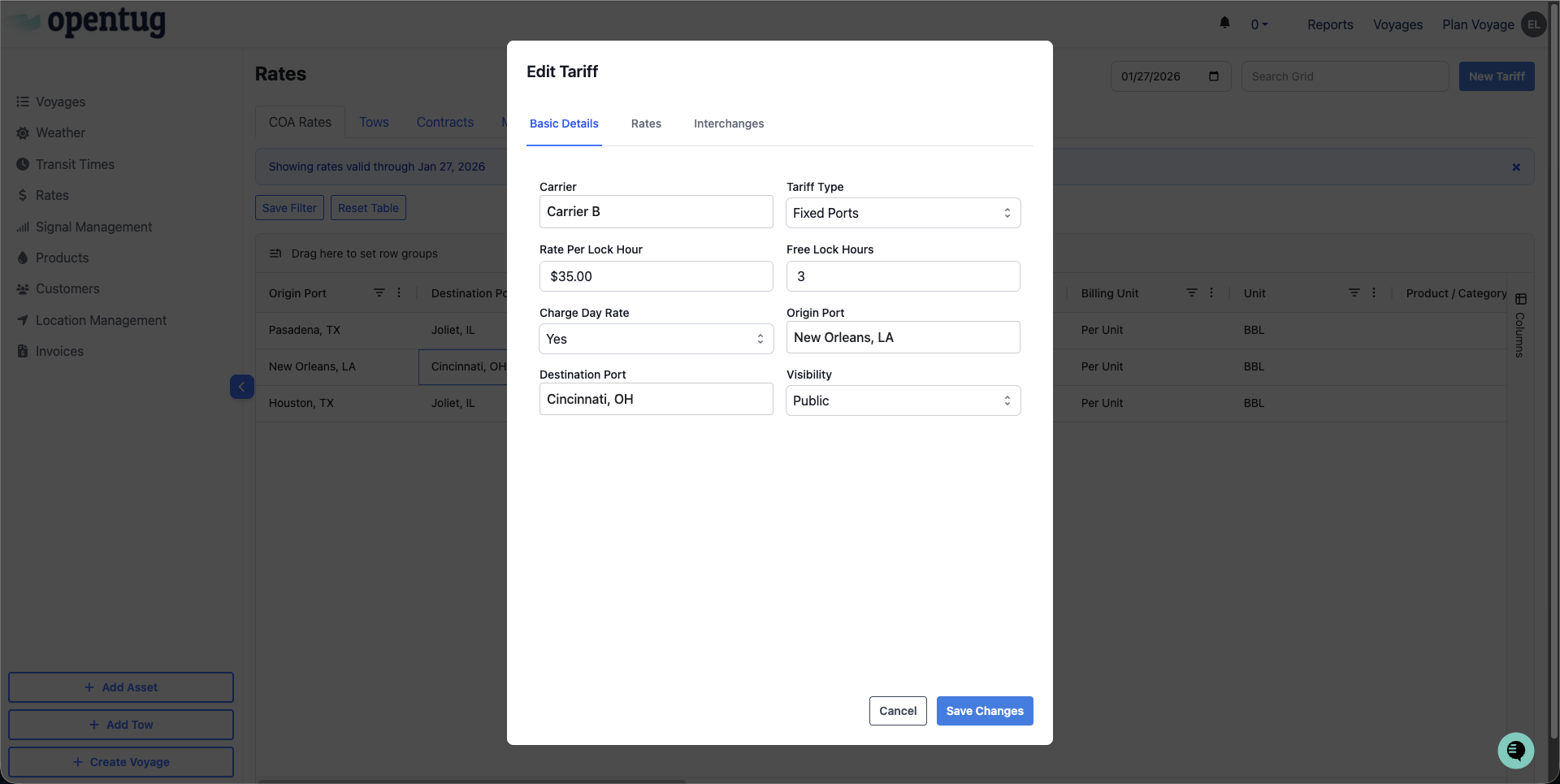
Basic Details
The Basic Details tab defines the scope and metadata of the contract.
Key fields:
Carrier
The carrier this COA applies to.Tariff Type
Fixed Ports - only applied with the exact Origin and Destination pair.
Along Route - applied to any voyage between the Origin and Destination pair.
Origin Port / Destination Port
Defines the contractual route.Rate Per Lock Hour (optional)
Used when lock delays are contractually billable.Free Lock Hours (optional)
Number of lock hours included before charges apply.Charge Day Rate
Controls whether daily charges apply in addition to unit pricing.Visibility
Public or private, depending on who should see and use the tariff.
Adding Rates to a COA Tariff
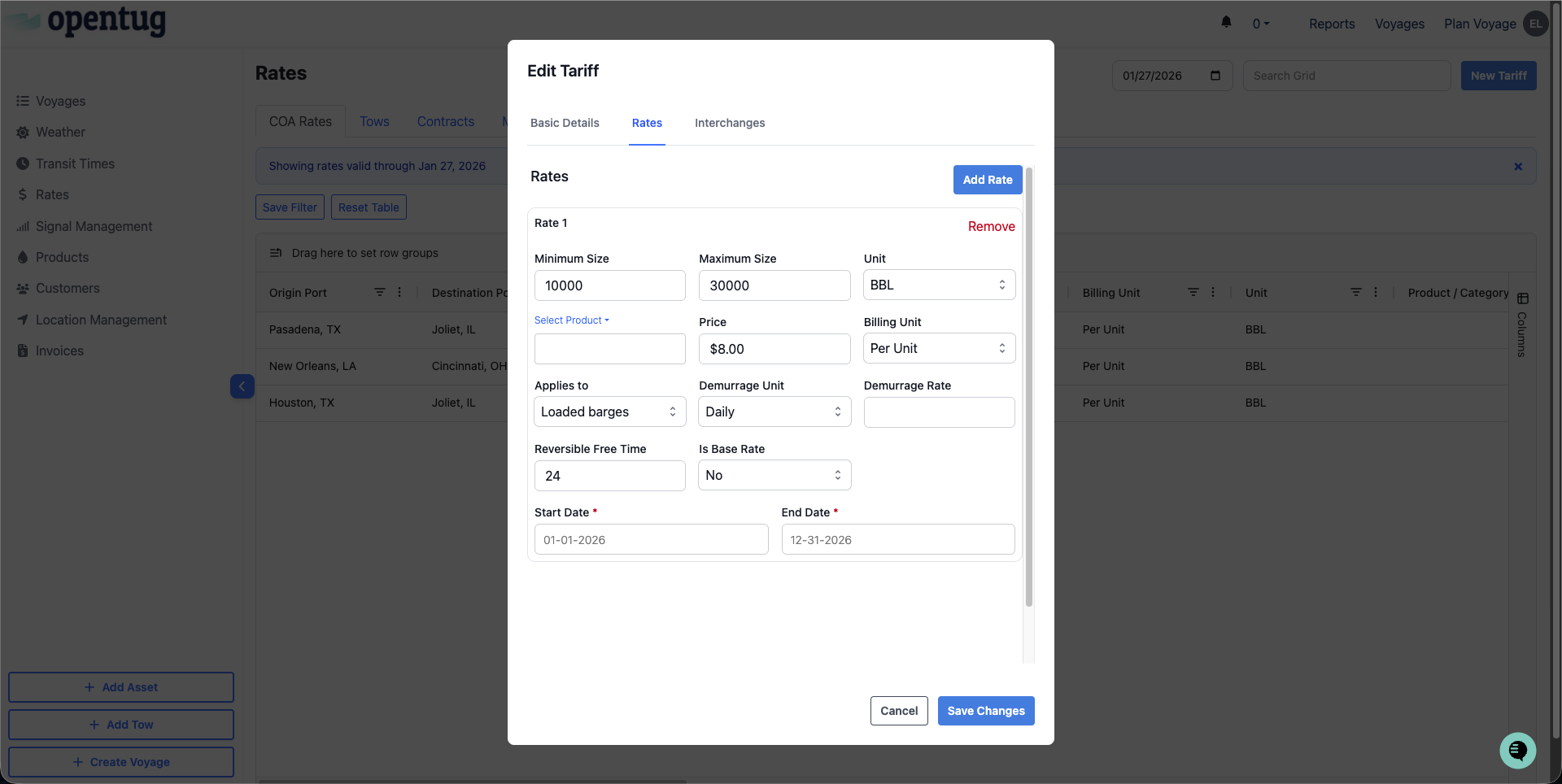
The Rates tab defines the actual pricing logic.
Each tariff can contain one or more rate rows, allowing for conditional pricing.
Rate Fields Explained
Minimum Size / Maximum Size
Defines the size range this rate applies to.
Unit
The unit used to evaluate size (e.g., BBL, TONS).
Price & Billing Unit
Defines how the charge is calculated (e.g., Per Unit, Per Mile, Fixed, Milage Per Ton).
Applies To
Controls whether the rate applies to Loaded or Empty barges
Base Rate
Controls whether this rate is considered the primary contractual charge.
Demurrage
Optional demurrage configuration including:
Demurrage unit (daily, hourly)
Demurrage rate
Free or reversible free time
Interchanges (Routing Logic)
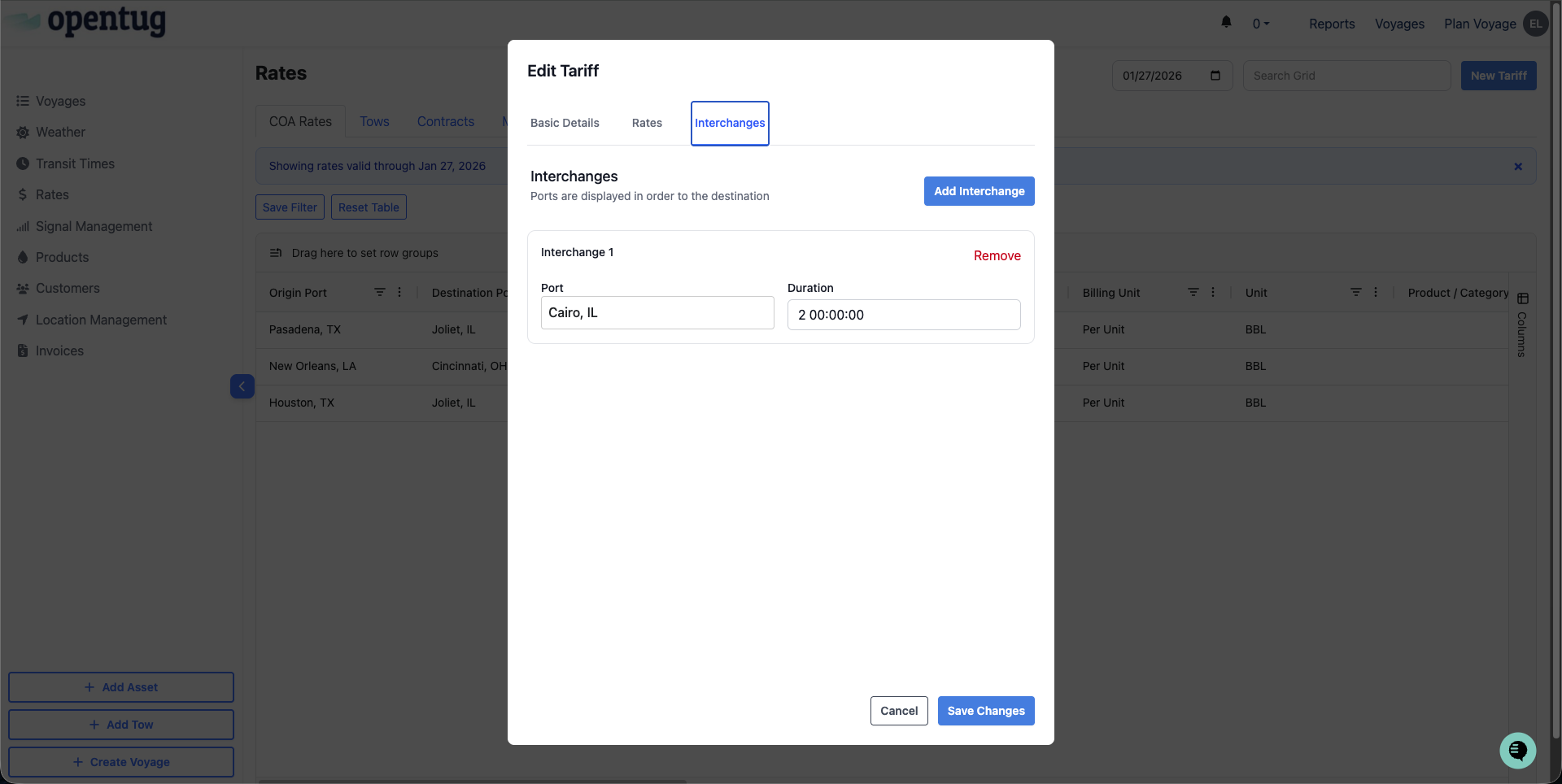
The Interchanges tab allows you to define intermediate ports that are part of the contractual routing.
How interchanges work
Interchanges are evaluated in order toward the destination
Each interchange can include an expected duration
Example:
Origin → Cairo, IL → Destination
How COA Rates Are Applied
When a voyage is planned, OpenTug evaluates:
Carrier match
Origin & destination
Barge volume vs min/max thresholds
Product (if specified)
Applies-to conditions
Date validity